With a resurgence in smutty reading, particularly in the fantasy genre, Michel Faber’s 2002 Victorian era historical fiction about a prostitute named Sugar’s rise through society isn’t a far-off planet or even an out-there theme. Striving for a Dicken’s-esque experience, Faber, through an aberrant narrator, takes readers through the lives of almost every character at some point, giving a peek into things that are normally swept under the bookjacket. The title draws inspiration from the 1847 poem “Now Sleeps the Crimson Petal”, by Alfred, Lord Tennyson.1 Although the poem is about a man expressing his love, most of the characters in The Crimson Petal and the White wouldn’t know love if it spread its legs open, inviting them to have a good time for a sixpence.
The narrator’s intrusive voice may sound risque at first but you quickly become enveloped in the gritty streets of 1875 London and realize that animals, including humans, relieve themselves on the sidewalk in any century. William Rackham is the ne’er-do-well heir of Rackham Perfumeries, whose eye-rolling antics weave all of the different perspectives together. Married at a tender age he has now grown bored with his wife Agnes and her ostensibly growing madness. With the help of school chums Bodley and Ashwell, who mainly serve as a gauge for how the typical man of that century behaved, William finds a substitute for his carnal desires in their copy of More Sprees in London. Hailed as a red-haired siren who will do things others won’t, Sugar appears to be just what the doctor ordered even if Faber doesn’t depict what the peculiar prescription is.
Ensnared by Sugar’s uncanny intellect and discretion when he underperforms, William coerces madam Mrs. Casteway to give up her acclaimed daughter. But mistresses aren’t as cheap as run-of-the-mill whores, especially when everyone wants a cut, so he finally agrees to assume the position his older brother Henry will not – head of Rackham Perfumeries. Henry, who gave up the family title to be an aspiring parson even though he can barely stomach a conversation with a prostitute, is surprisingly one of the most genuine characters, but readers don’t get enough time inside of his point of view. Luckily for Sugar’s dry skin (most likely eczema, which William obtusely calls tiger stripes) and status, this new lavish arrangement allows her to focus on her own penny dreadful tale about a prostitute set on vengeance against the “eternal Adam”.
Supporting a family and a mistress may be commonplace in the late 19th-century but Faber allows you to feel sympathy for naive Agnes’ plight by sharing a hidden secret bored behind her left eye. This obviously goes unnoticed by dimwitted Dr. Curlew who is hasty to ship her off to rest, a method that could be a companion story to Charlotte Perkins Gilman’s The Yellow Wallpaper. William’s paramour and Agnes’ angel eventually transforms from overpaid albeit underworked seductress into governess and interim secretary, but without the firsthand narrative that is the books staple the readers are just left to assume that William agreed to this arrangement because of how he fell for her literary knowledge at the Fireside or her help making Rackhams successful under his reign.
The numerous descriptions of female arousal are obviously written by a man, but the forced intimacy on Agnes by William is thankfully vague. Even Henry gets caught up in carnal desires for the tenacious widow Mrs. Fox, but the fanning of these flames becomes his downfall. Mrs. Fox, another Victorian-era anomaly, is not some puritanical Christian, but rather a hands-on aristocrat whose support of the Rescue Society brings her closer to the seedy underbelly of Sugar’s world; however, stepping inside a brothel is as close to sex with an actual person as she gets during this story. Sugar’s secret life is kept safe by those that are privy to it since she “would rather die than go back” to prostitution. Yet when William’s high society neighbor and confidant questions Sugar’s skills as a governess, she learns she can’t maintain the life she’s grown accustomed to forever.
Sugar’s skin isn’t the only thing with cracks in it. Faber, for once, lets the narrator abruptly end things “You imagine you can make it last forever, then suddenly it’s over”. Much like the unsatisfied feeling William, Bodley, and Ashwell are left with in the alley during one of the more grotesque scenes, readers might want more inside information about everyone’s fate. Even the 2011 BBC four-part miniseries fails to provide clarity into the world Farber created, not surprising for a book to screen adaptation. However, writing about explicit sexual endeavors doesn’t make a groundbreaking story when things that could vastly elevate the plot get overlooked. Why take up innumerable pages describing a harlot’s douching, escapades with buffoonish friends, or lush lavender fields when the characters you’ve spent so much time with futures are left hanging in the balance? Fans of modern historical romances like Bridgerton might find Farber’s narrator charming and the story authentic but alas dear reader, this one doesn’t.
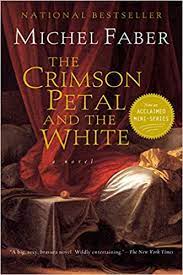
From the Back Cover
At the heart of this panoramic, multidimensional narrative is the compelling struggle of a young woman to lift her body and soul out of the gutter. Faber leads us back to 1870s London, where Sugar, a nineteen-year-old whore in the brothel of the terrifying Mrs. Castaway, yearns for escape to a better life. Her ascent through the strata of Victorian society offers us intimacy with a host of lovable, maddening, unforgettable characters. They begin with William Rackham, an egotistical perfume magnate whose ambition is fueled by his lust for Sugar, and whose patronage brings her into proximity to his extended family and milieu: his unhinged, childlike wife, Agnes, who manages to overcome her chronic hysteria to make her appearances during “the Season”; his mysteriously hidden-away daughter, Sophie, left to the care of minions; his pious brother, Henry, foiled in his devotional calling by a persistently less-than-chaste love for the Widow Fox, whose efforts on behalf of The Rescue Society lead Henry into ever-more disturbing confrontations with flesh; all this overseen by assorted preening socialites, drunken journalists, untrustworthy servants, vile guttersnipes, and whores of all stripes and persuasions.
 E.J. Inkmire